


You finish a late shift, get home, open your banking app and see another mortgage repayment leave the account.
Quick question: when did you last check the rate itself, not just the amount? If the honest answer is “when I got the loan”, there’s a good chance you’re paying what amounts to a loyalty tax. Banks reserve their sharpest pricing for new customers and for the ones who ask.
This one gets a little technical. Stay with it, because understanding how your rate is actually set is the difference between hoping for a discount and knowing you’re entitled to one.
How your rate is really decided: the risk ladder
Your rate is priced on risk. The key measure is your loan-to-value ratio, or LVR: your loan as a percentage of your property’s value.
The lower your LVR, the easier it is for a lender to recover its money if it ever had to sell the property. So the less it charges you. As your LVR falls, you step down a ladder of discounts.
Say your home is worth $1 million and your outstanding mortgage is $750,000. Your LVR is 75%.
| LVR | What it can mean |
|---|---|
| 95% | Many borrowers can’t get a loan at all, and those who can are paying close to the most expensive rates in the market, unless you’re an eligible doctor or specialist with profession-based policy on your side. |
| 90% | More lenders say yes, but LMI commonly applies on top of pricing that’s still well above the sharpest available, unless you’re an eligible nurse, midwife or allied health professional with access to a waiver. |
| 80% | The important threshold. LMI generally isn’t required, and a genuine discount to your rate becomes available. |
| 70%, 60% and below | Further discounts can unlock at each step, though they taper off. The bank still wants to make money. |
These are general examples, not universal pricing tiers. Each lender has its own credit policy and eligibility requirements, and both can change.
Size matters too
Banks also price for volume. Larger loans, usually above $1 million, often attract additional pricing discounts because the customer is worth more to the lender. Smaller loans can actually be priced less aggressively.
It isn’t fair. It’s just how the pricing works, and knowing it helps you negotiate from a position of information rather than guesswork.
Why you might already be entitled to a discount
Here’s where the ladder gets interesting.
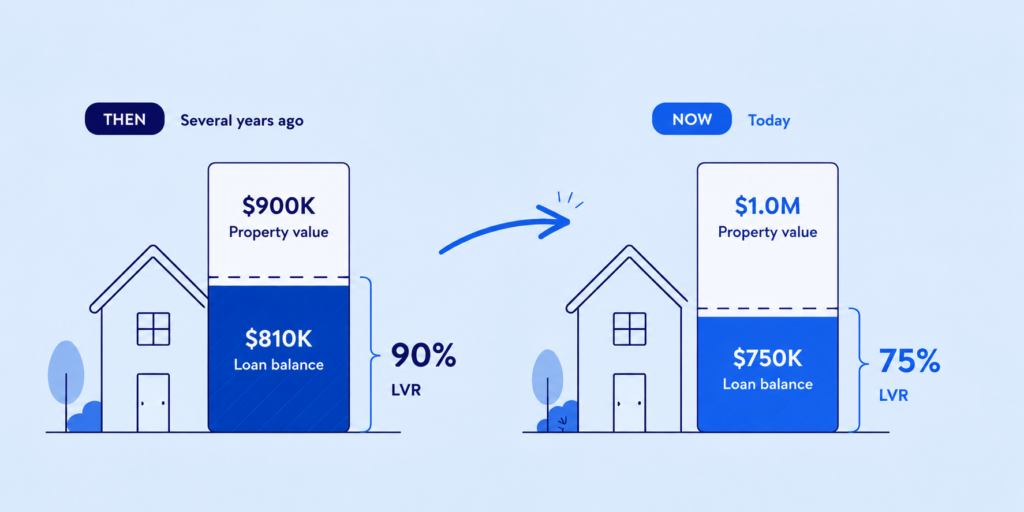
Suppose you bought a property several years ago for $900,000 with an $810,000 mortgage. That’s a 90% LVR.
Since then, your loan balance has fallen and your property’s value has likely risen. Imagine the outstanding loan is now $750,000 and a current valuation puts the property at $1 million.
Your LVR is no longer 90%. It’s 75%.
That’s a discount you may already be entitled to. Your bank isn’t going to call and tell you.
The same applies if you’ve recently rolled off a fixed rate. The “revert” rate you land on is rarely the sharpest one available, and it’s absolutely negotiable.
What a small rate difference is actually worth
Percentages look unimpressive on a screen. On a large mortgage, they aren’t.
Take a hypothetical $800,000 owner-occupier loan with 25 years remaining.
| Rate | Monthly principal and interest repayment |
|---|---|
| 6.00% | approximately $5,154 |
| 5.80% | approximately $5,057 |
| Difference | approximately $97 per month, or around $1,160 in the first year |
This is only an illustration. Real savings depend on your balance, remaining term, fees and how long you keep the loan. But it explains why “it’s only 0.2%” is the wrong way to think about mortgage pricing.
The habit: ask every 6 to 12 months
Treat your home loan like your health: a regular check-up, not a once-a-decade event.
Every 6 to 12 months, ask your lender to review your pricing, plainly and directly. Tell them your current rate, your approximate LVR and the comparable rates you’re seeing elsewhere.
The worst they can say is no. A small cut compounds into serious money over the life of a loan.
The insider move: ask for a discharge
If an ordinary request for a discount gets nowhere, telling your lender you want to discharge the loan changes the conversation. In some cases, submitting the discharge paperwork is what actually gets their attention.
That’s usually the point where you hear from the retention team, the people with real authority to move your rate. A front-line call centre can offer scraps. Retention can make a genuine difference.
One word of caution: if you’re on a fixed rate, check for break costs before lodging any paperwork. Be prepared for the possibility the bank processes the discharge instead of countering. Know your next move before you make the call.
And if they still won’t move
A lower advertised rate elsewhere isn’t automatically a reason to switch. Refinancing starts to make sense once the benefit still stands up after the cost of moving is included.
Suppose refinancing saves you $180 a month but costs $1,800 in total. Your rough break-even period is:
$1,800 ÷ $180 = 10 months
If you plan to keep the new loan for years, that’s usually a reasonable trade. If you’re planning to sell in six months, it isn’t.
Refinancing isn’t only about the rate
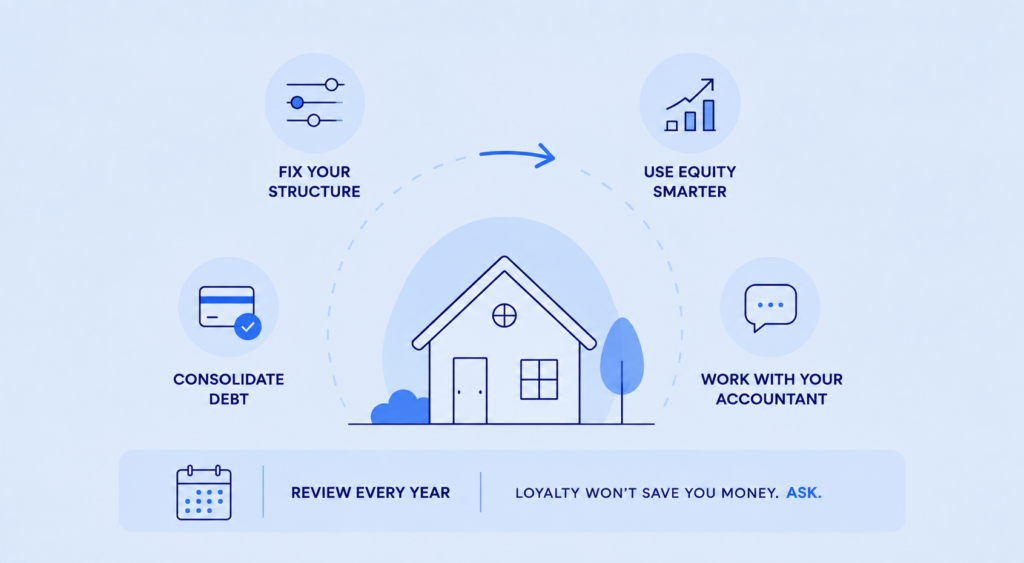
A refinance is also the natural moment to fix your loan’s structure: adding an offset account, sorting fixed versus variable, consolidating expensive debt, or shortening the loan term while conditions favour you.
For some borrowers, it opens a bigger conversation. If you’ve largely paid off your home, or you’re carrying a meaningful amount of non-deductible debt, it may be worth a conversation with your accountant about debt recycling: drawing on home equity to invest, where the interest on the borrowed amount may be deductible. That’s a tax question, not a lending one, so it belongs with your accountant. We handle the structure alongside it.
Loyalty is a virtue everywhere except your mortgage. Lenders price for the customers who ask, so be one of the ones who asks, every year, without exception.
Start with a free 15-minute call
This is exactly what a Financial Fitness Check is built for: reviewing your current rate, working out where you actually sit on the LVR ladder, and telling you honestly whether to negotiate, refinance or stay put.
Bring your latest statement. A mortgage runs for 25 or 30 years, and your income, your property value and interest rates will all change well before it’s paid off. Your current loan should keep up.

Book your free Financial Health Check →
This information is general in nature and does not take into account your objectives, financial situation or needs. Lending criteria, eligibility requirements, rates and lender policies apply and can change. Refinancing or discharging a loan may involve fees and other costs. Tax treatment depends on individual circumstances. Seek advice from a registered tax agent or accountant regarding tax matters.



0 comment