
You have two loan offers open in different browser tabs. One shows a headline rate of 5.79% and a comparison rate of 6.15%. The other shows 5.95% and 5.95% flat. On paper, the second one looks cheaper. It is not, at least not for the loan you are about to sign. Understanding interest rate vs comparison rate matters most for first home buyers. The comparison rate rests on a loan almost none of you will ever take out. This piece shows you how to read both numbers, and which one to trust for your actual purchase.
The interest rate is the annual cost of borrowing, which you pay on your balance each month. The comparison rate blends that rate with most standard fees into a single figure. However, it assumes a $150,000 loan over 25 years. That figure rarely matches what a first home buyer actually borrows.
What the comparison rate actually measures
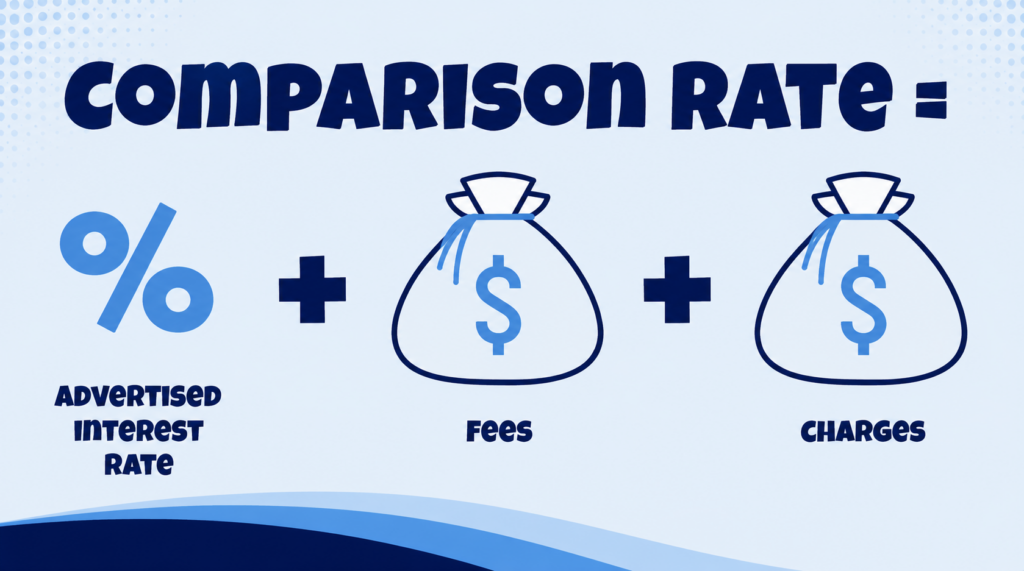
Every Australian lender calculates the comparison rate the same way. Specifically, they apply a standard example the law prescribes. It is a $150,000 loan repaid over 25 years, with monthly principal and interest repayments. The figure then combines the headline interest rate with most upfront and ongoing fees.
This standard exists for a good reason. Because lenders once advertised low headline rates while hiding fat fees in the fine print, the government stepped in. Two laws sit behind this: the National Consumer Credit Protection Act 2009 and the National Credit Code. Both now require a comparison rate beside every advertised rate. Furthermore, the two figures must appear with equal prominence. No lender can bury the honest number in grey 6-point type.
The formula itself is sound. It takes the interest rate and adds application fees, ongoing account fees, and discharge costs. Then it expresses the total as a single annual percentage. For a plain-English breakdown, ASIC’s MoneySmart explains how the figure works. The catch is not the maths. Instead, it is the fixed example the maths runs on.
Why the comparison rate misleads first home buyers
The comparison rate assumes you borrow $150,000. Most first home buyers borrow far more, often $500,000 or higher. Because fixed fees shrink as a share of a bigger loan, the comparison rate can flip which loan looks cheaper. As a result, the ranking it gives you may be backwards for your real purchase.
A worked example that flips
Take the two offers from earlier. Loan A charges 5.79% with a $395 annual package fee. Loan B charges 5.95% with no ongoing fee. On the standard $150,000 example, Loan A’s comparison rate climbs to 6.15%. Loan B, by contrast, sits at 5.95%. By that measure, Loan B wins clearly.
Now run the same two loans over a realistic first home purchase: $650,000 borrowed across 30 years. Suddenly Loan A costs roughly $12,000 less over the full term, about $33 a month. The $395 fee barely registers against a loan that size. So the lower interest rate does the heavy lifting instead. In other words, the comparison rate reversed the answer.
| Scenario | Loan A (5.79% + $395/yr) | Loan B (5.95%, no fee) | Comparison rate favours | Actually cheaper |
|---|---|---|---|---|
| Standard: $150,000 over 25 yrs | 6.15% comparison | 5.95% comparison | Loan B | Loan B |
| First home buyer: $650,000 over 30 yrs | 5.87% comparison | 5.95% comparison | Loan A | Loan A, by about $12,000 |
Why the gap matters on a big loan
The lesson is not that the comparison rate lies. It follows its formula perfectly. The problem is scale. A $395 fee is real money on a $150,000 loan. Yet it becomes a rounding error on $650,000. Therefore, a loan with a modest fee and a lower headline rate can look worse on the comparison rate. In real life, it may perform better. First home buyers, who borrow large and hold their loans for decades, feel this distortion most of all.
The costs the comparison rate hides
Neither number tells the whole story. Notably, the comparison rate leaves out several real costs, and it ignores features that save you money. Meanwhile, the headline interest rate ignores fees entirely. To compare loans properly, you need to know what each figure quietly excludes.
Here is what the comparison rate does not capture:
- Offset and redraw value. An offset account can save a first home buyer thousands in interest, yet the comparison rate gives it no weight. In practice, knowing how an offset account works often matters more than a 0.1% rate gap.
- Government and third-party costs. Stamp duty, mortgage registration, and lenders mortgage insurance sit outside the formula altogether.
- Expiring introductory rates. A sharp 2-year fixed rate can flatter the comparison figure, then revert to something far higher.
- Discounts you negotiate. The advertised rate is a starting point, not the rate a broker can often secure for you.
For a first home buyer, the biggest hidden cost is usually insurance, not the rate at all.
Beyond the interest rate: what healthcare buyers overlook

For healthcare workers buying a first home, the rate is rarely the biggest lever. Instead, whether you pay lenders mortgage insurance shifts your real cost far more. Notably, many lenders waive that insurance for eligible healthcare professionals. That single benefit can save tens of thousands upfront.
Lenders mortgage insurance, or LMI, applies when you borrow above 80% of a property’s value. On a $650,000 purchase with a small deposit, that premium can run past $20,000. However, a number of lenders waive LMI for doctors, nurses, and other healthcare workers, typically those registered with AHPRA. Some do so even at a 90% loan-to-value ratio. That single policy dwarfs any comparison-rate difference you were agonising over.
So before you rank two loans by a decimal point, check whether one of them removes the insurance cost altogether. This is also where the wider rate environment matters. The Reserve Bank of Australia has held the cash rate at 4.35% through 2026. Variable rates have stayed high as a result. That makes fee structures and LMI waivers count for even more. To see how the numbers land on your deposit, estimate how much you can borrow first.
Interest rate vs comparison rate: how to compare without getting fooled
Use the comparison rate as a smell test, not a verdict. First, it flags loans with hidden fees. Then, once you have a shortlist, model your actual loan amount and term. Finally, factor in offset value and any LMI waiver you qualify for.
Here is the order that works:
- Scan the comparison rate for red flags. If it sits far above the headline rate, the loan carries heavy fees worth questioning.
- Run your real numbers. Model your genuine loan size and term, not the $150,000 example. If you are buying your first home, the true figure is usually five or six times the standard.
- Add the features you will use. Price in offset savings and extra-repayment flexibility.
- Check your LMI position. Confirm whether a waiver removes the insurance premium entirely.
- Then compare the total cost. Over your real term, one loan will cost less overall. That number, not the advertised rate, is the one to sign for.
This is the work a good broker does for you in an afternoon. Ultimately, it is also why the cheapest advertised rate and the cheapest loan are often two different products.
Your next move before you sign
The comparison rate exists to protect you, and it does flag the worst offenders. Still, it answers a question you are not asking, because you are not borrowing $150,000 over 25 years. Your real cost depends on your loan size, your deposit, and the features you use. It also depends on whether you pay LMI at all. So run those numbers before you commit to a rate that only looks good on a government example. Want to see what your file actually qualifies for, and which loan is genuinely cheapest for your purchase? Then book a fifteen-minute Discovery Call.
Information current as of July 2026. Lending criteria vary by lender and are subject to change. This is general information, not personal financial advice.